Build with SoundSync
Build with SoundSync
Build with HISEScript, native HISE, JUCE, or custom HTTP, and connect storefronts and approved partner fulfillment.
SoundSync
Checkout and commercial details
| Question | Current support |
|---|---|
| PayPal accepted at checkout? | Yes. PayPal is accepted for one-time purchases. Subscription checkout uses Stripe. |
| Stripe checkout? | Yes. Stripe supports card payments and available wallets; choices depend on the customer and checkout configuration. |
| Supported currencies? | USD only currently. Prices and checkout charges are presented in US dollars. |
| Developer payout schedule? | Twice monthly, on the 1st and 15th, through Stripe Connect. A minimum 14-day payment hold applies. |
| Native affiliate programs? | Yes. Product-scoped referral agreements, links, attribution, and allocated earnings. |
| Collaborator revenue sharing? | Yes. Product-specific agreements and separately tracked recipient shares. |
| Reseller integrations? | Yes. Approved relationships, assigned products, external orders, serial fulfillment, and partner APIs. |
| Assisted Gumroad migration? | No. SoundSync does not offer an assisted Gumroad migration service. |
| Pay-what-you-want pricing? | No. SoundSync does not support pay-what-you-want pricing. Paid checkout offers start at $9.99 after discounts, before tax. |
SoundSync
Choose by build environment
| Path | Use it when | Integration responsibility |
|---|---|---|
| HISEScript | You want licensing without modifying HISE source | Include the generated script runtime; test script-level enforcement in your project |
| HISE C++ | You can rebuild HISE and the exported plugin | Install native sources, patch and rebuild HISE, then patch and build the export |
| JUCE 0.7.0 | Your plugin or application uses JUCE | Own licensing in the processor; attach the editor UI and guard every audio callback |
| Custom HTTP | You maintain your own runtime and activation interface | Implement transport, ownership, device identity, storage, revalidation, and access decisions |
| Storefront embed | You already have a website | Install the full commerce package or select a standalone content embed |
| Partner API / WooCommerce | An approved reseller sells your products externally | Agree product scope, delivery model, mappings, credentials, and refund handling |
Licensing and storefronts solve different jobs
Licensing determines whether a customer and device can use a product. Store and My Products provide browsing and owned-product access. A hosted or embedded website is not the same thing as a plugin licensing package.
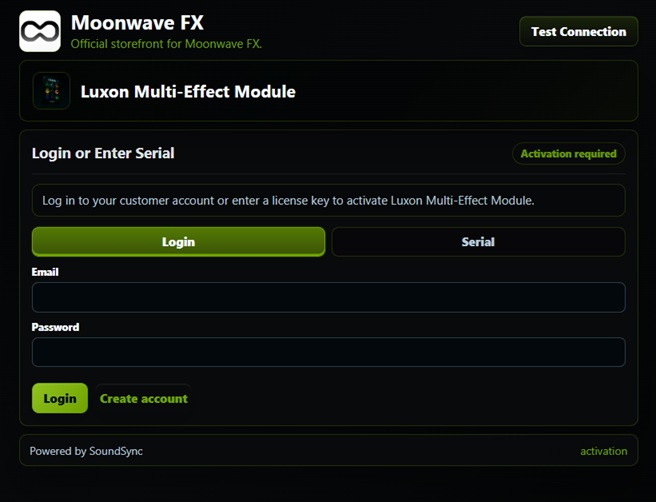
A Test Connection result confirms product credential connectivity, not customer ownership, activation, audio unlock, or completed checkout.
Offline support depends on the package
JUCE 0.7.0 requires online renewal at startup. Valid saved credentials are reused without repeated sign-in, but offline audio access is unavailable in this release. HISEScript offline grace is a different package policy.
HISEScript can use configurable offline grace after a prior valid state. Confirmed invalid or revoked access must not become offline-valid. Native HISE and custom clients must follow their own generated contract rather than inherit a promise from another package.
SoundSync
Start with the matching guide
SoundSync
Beyond plugin activation
SoundSync
Affiliates, collaborators, and team members
Affiliate programs
Agreements, referrals, attribution, and earnings.
Collaborator sharing
Product-specific contribution agreements.
Recipient payout policy
Funded shares, consent, eligible balances, and adjustments.
Team Accounts
Dashboard access is a separate permission.
SoundSync
Inside SoundSync