SoundSync API and Custom Integration
SoundSync APIs and Custom Clients
SoundSync's public API is backed by an endpoint catalog, OpenAPI schemas, stable errors, executable examples, package parity checks, and release gates that prevent unsupported behavior from appearing in the docs.
Product credentials
Activation request
Entitlement check
Device registration
Periodic validation
Deactivation when needed
Use the credential model for the job
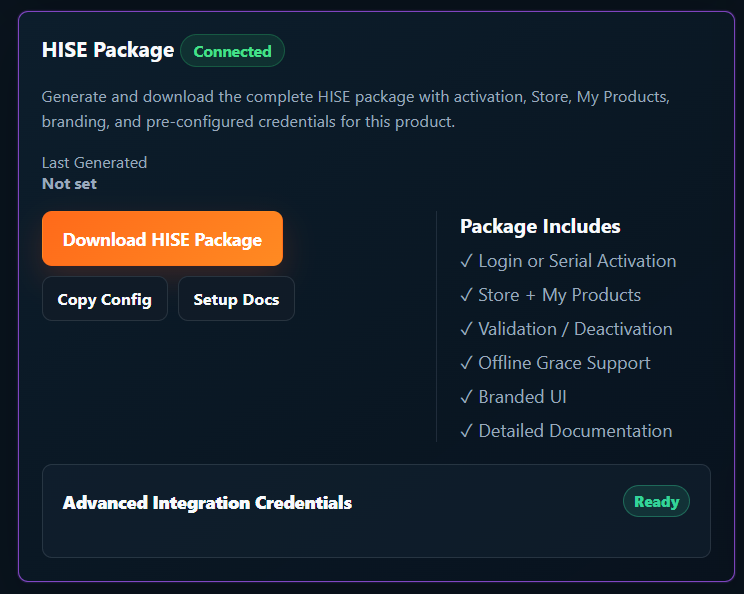
Product licensing uses product-scoped credentials. Developer dashboard operations use the authenticated workspace and permissions. Approved partner integrations use separate Bearer credentials. Customer library and storefront sessions have their own access paths.
From activation to operations
The references cover activation, validation, deactivation, claims, branding, library access, checkout, delivery, subscriptions, promotions, marketing, analytics, teams, partners, and webhooks. Newer operation maps identify current source routes without pretending untested examples are live transcripts.
Integrate explicitly
Use the documented method, authentication, scope, request fields, errors, and retry/idempotency behavior for each endpoint. Do not send developer or partner tokens inside distributed plugin code. Custom HTTP clients own their local state and audio enforcement.
SoundSync
Find a contract
SoundSync
Inside SoundSync