
Integration guide
Custom JUCE and C++ Integration
Use the JUCE package when possible, or integrate directly with the SoundSync HTTP licensing API from a custom C++ client.
SoundSync
Serial validation in a native client
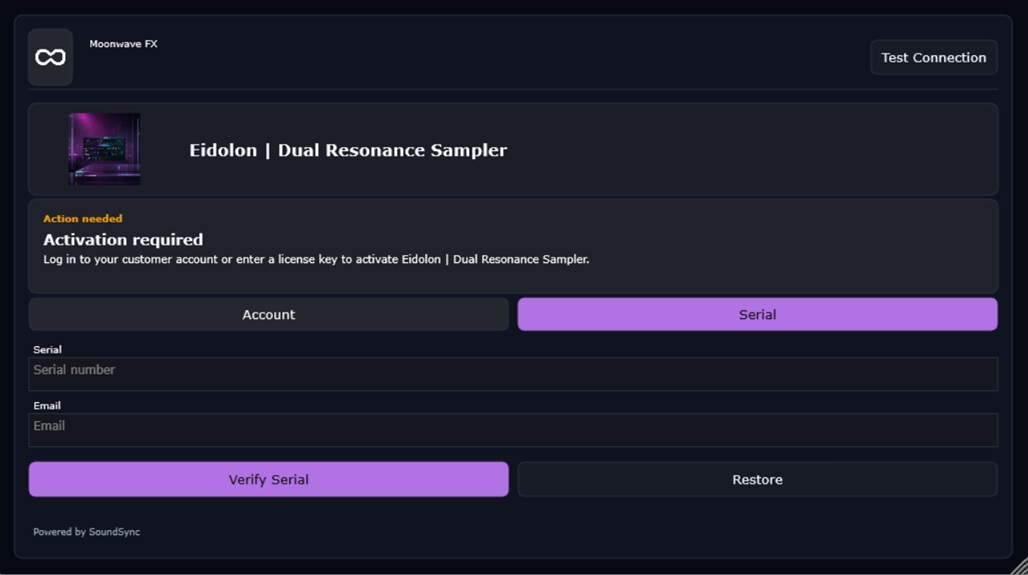
The JUCE serial screen shows the customer-facing shape custom C++ clients should model: product-scoped serial entry, customer identity, validation action, and activation state.
SoundSync
Customer access after login
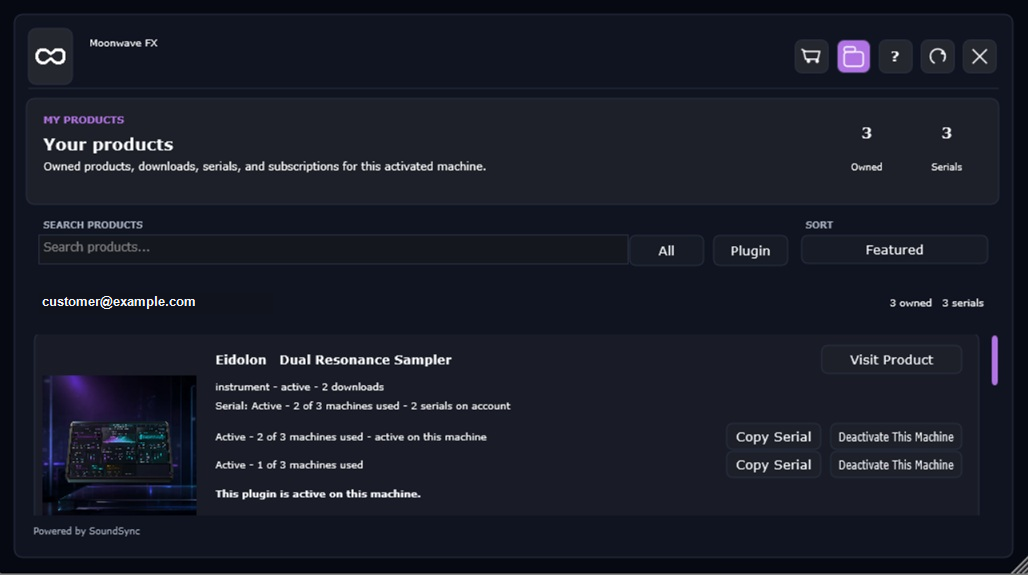
The JUCE My Products screen shows the ownership, serial, and device-management state custom integrations should keep aligned with SoundSync validation results.
SoundSync
Path selection
Choose one path per product build and keep credential handling consistent.
| Path | Use it when | Public guidance |
|---|---|---|
| JUCE package | Your product is JUCE-based and can consume the package module/CMake structure. | Use /docs/juce-package. |
| Custom C++ HTTP client | Your app is not JUCE or has a custom networking/storage/UI stack. | Use product credential headers and API endpoint docs. |
| HISE C++ package | Your product is HISE and you can patch/rebuild HISE for native-authoritative enforcement. | Use /docs/hise and /docs/hise/package-files. |
SoundSync
Core endpoint groups
Custom clients should implement the same lifecycle as the packages.
Test connection
POST /api/plugin-connections/verify confirms product, app, credential, version, and environment before customer activation.
Claim and claim status
POST /api/license/v1/claim and GET/POST /api/license/v1/claim-status support serial claims and email verification.
Activate
POST /api/license/v1/activate and POST /api/license/v1/customer-login/activate create or restore machine access.
Validate
POST /api/license/v1/validate refreshes active access, token state, subscription state, offline grace, and denial decisions.
Deactivate
POST /api/license/v1/deactivate releases the device and should clear local activation state.
Branding and library
Use branding, library token, WebView/library, download, subscription, and support endpoints only where the customer context is authorized.
Credential handling
Do not expose product secrets in public logs, screenshots, tickets, or customer-facing UI. Native packages reduce the secret footprint, but any credential material distributed in client software should be treated as extractable by a sufficiently capable attacker.